
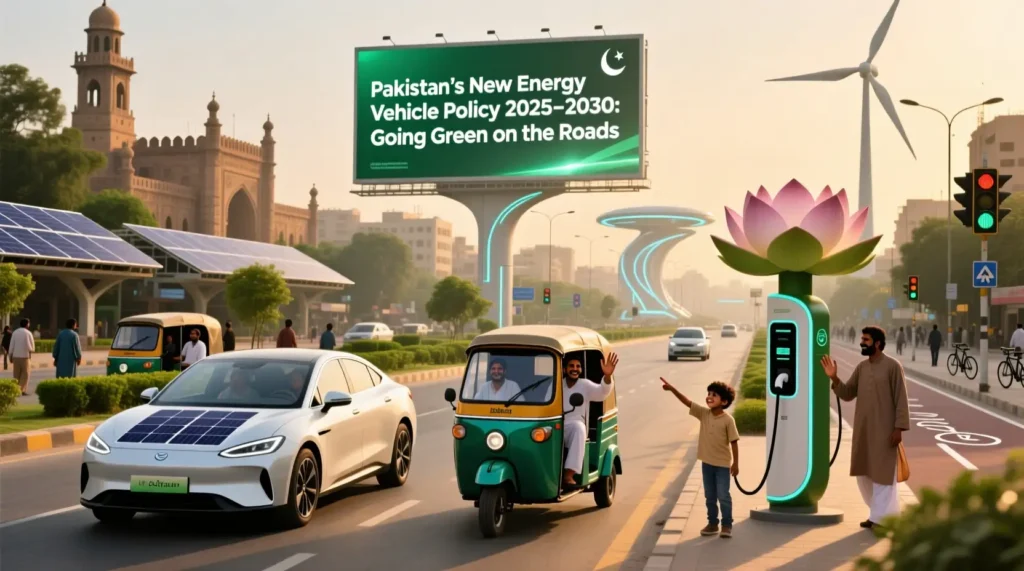

Pakistan’s latest push towards electric vehicles (or NEVs, as they’re calling them now) is pretty exciting. Back in 2019, we had our first stab at an EV policy, but life threw curveballs like COVID, and things didn’t pick up as fast as hoped. Fast forward to 2025, and we’ve got this fresh New Electric Vehicle Policy for 2025-2030. It’s all about ditching fossil fuels, cleaning up the air, saving bucks on oil imports, and building a homegrown industry that creates jobs. I’ll break it down in a chill way, like we’re chatting over chai. No jargon overload—just the good stuff.
Why This Matters Now
Our world’s heating up faster than a summer day in Karachi, and transportation’s a big culprit pumping out emissions. Pakistan’s smack in the middle of climate chaos—think melting glaciers, killer smog in cities like Lahore, and economic hits that rank us as one of the hardest-hit countries. The old policy aimed high but needed a refresh. This new one, rolled out in August 2025 under Prime Minister Shehbaz Sharif, is backed by the IMF with a $1.4 billion boost and even a $1.8 million grant from the IFC to kickstart local EV production.
It’s not just talk; it’s about real change. We’re aiming for 30% of new vehicle sales to be electric by 2030, cutting emissions by half by the end of the decade, and eventually hitting a net-zero transport system by 2060. The government, along with provinces, industry folks, and experts, teamed up to make this happen. Shoutout to the Ministry of Industries and Production for leading the charge—pun intended!
Acknowledgements: Who Made This Possible?
This policy didn’t just appear out of thin air. It took over 100 stakeholders chatting it out—government ministries, auto makers, battery pros, universities like LUMS, banks, and even civil society groups. They fixed what went wrong last time, like slow implementation and overlooked hurdles. Big thanks to the Steering Committee chaired by the PM, working groups, and international helpers who brought in global know-how. Without folks from REMIT and local experts, we might still be stuck in neutral.
Executive Summary: The Big Picture
Alright, let’s cut to the chase. Pakistan’s transport sector is guzzling oil—about $13 billion a year in imports—and spewing 43% of our airborne junk, especially in places like Punjab. EVs (or NEVs, including hybrids and such) can fix that by slashing emissions, using up our excess electricity (we’ve got tons sitting idle), and sparking a new industry full of green jobs.
From a measly 567 EVs in 2021, we’re up to over 80,000 by mid-2025. The goal? 30% EV sales by 2030, 50% by 2040, and 100% zero-emission by 2060. We’ll roll this out in phases: building awareness and markets first, then ramping up local manufacturing and exports. Expect subsidies, better charging spots, and rules to keep things safe and eco-friendly. By 2030, this could save us nearly a billion bucks in oil, cut 4.5 million tons of CO2, and even rake in carbon credits worth $58 million. Plus, healthier air means fewer doctor visits—worth about PKR 4.5 billion in savings.
Policy Objectives: What We’re Aiming For
Simple goals here, folks:
- Slash greenhouse gases and smog to meet our global climate promises.
- Make better use of our extra power, cut oil bills, and boost transport efficiency.
- Build a full NEV ecosystem—chargers, skills training, innovation, you name it.
- Grow local manufacturing to drop costs and start exporting parts.
- Set strict rules for safety, quality, and recycling batteries without trashing the environment.
- Get everyone on board—federal, provincial governments, even GB and AJK.
- Keep tabs on progress and tweak as we go.
Introduction: The Road Ahead
Globally, EVs are exploding—think 250 million on roads by 2030, per the IEA. Pakistan can’t miss this boat; it’s our chance to fight pollution, save cash, and join the export game. We’ve set yearly targets for everything from bikes to trucks. For example, by 2030, we’re targeting over 2 million NEVs sold cumulatively. And yeah, with smart planning, these vehicles will charge during off-peak hours, easing grid stress and cutting idle power costs.
Charging Infrastructure: Plugging In Everywhere
No one’s buying an EV if they can’t charge it, right? So, the plan is to slap in 3,000 public charging stations by 2030—mix of fast (Level 3), medium (Level 2), slow (Level 1), and battery-swapping spots. Kickoff: 40 fast chargers along motorways and the N5 highway in the first six months. Eventually, one every 50 km on roadsides.
Power companies (DISCOs) have to step up—smart meters, quick connections (under three weeks), and a special tariff of PKR 39.7 per kWh to keep it affordable yet profitable. Oil stations? They gotta add chargers to 10% of their spots. New buildings will need charging setups, and there’s a national app coming to map it all out. For tough spots, government’s chipping in with viability funding via public-private deals.
Policy Incentives: Making EVs Affordable
Different vehicles, different needs, but everyone’s getting a boost.
Incentives for Two and Three-Wheelers
These are huge in Pakistan—over 20 million already on roads. Subsidies start high (up to PKR 65,000 for 2-wheelers, PKR 400,000 for 3-wheelers) and taper off. Free registration in Islamabad (provinces, hop on!), no tolls on highways, and easier loans from banks.
Incentives for Cars and Light Vehicles
For 4-wheelers like cars and small trucks, subsidies up to PKR 200,000-300,000. Same perks: free reg, toll exemptions, and green financing. Public offices must buy NEVs only starting now for bikes, and all vehicles by 2027.
Incentives for Buses and Trucks
Bigger subsidies here—PKR 700,000 for buses, PKR 300,000 for trucks—to make commercial sense. Prioritize electrifying metro and BRT routes. For trucks, start with city hauls, then expand to long-distance with better infra.
Manufacturing and Components Boost
Want local factories? Import machinery duty-free, get 5-year tax breaks for new plants, and low-interest loans (5%). Encourage battery and motor making with 1% import duties on parts. For exports, align with WTO rules. Plus, a skills program to train 15,000 folks in EV tech.
Charging and Battery Perks
Install chargers and count it as CSR. Import gear at 1% duty. New tech like wireless charging? Green light with incentives as it evolves.
Registration and Standards: Keeping It Safe
New rules for registering based on motor power, with special plates for easy perks like EV zones. Adopt global standards (UNECE WP.29) for safety—crash tests, battery fire prevention, all that. NEECA handles charger standards. And for emergencies, train Rescue 1122 on EV fires.
National Center and Committees: Who’s Running the Show?
A new National Center for Electric Vehicles (NEVC) to test, innovate, and push local production—aiming for 80% indigenization by, say, 2028. An inter-ministerial committee (chaired by MoIP) oversees everything, with provinces involved. Model cities like Islamabad get extra love with dense chargers and green taxis.
Roles of Ministries and Agencies: Team Effort
- Ministry of Industries & Production: Leads, sets models, links industry and academia.
- Ministry of Climate Change: Tracks emissions, ties to national GHG goals.
- Power Division: Blueprints R&D, ensures grid readiness.
- Finance and FBR: Handles tax breaks, subsidies.
- SBP: Lowers loan barriers for buyers and makers.
- Provinces: Cut local taxes, update laws, build chargers.
- NTDC/NEPRA: Smart grids, tariffs, standards.
And more—Foreign Affairs woos international partners, Communications plans highway chargers, you get it.
Wrapping Up: A Greener Future
This policy’s a game-changer if we stick to it. Sure, there are hiccups like grid strains or battery waste, but with recycling plans and carbon finance, we’re on track. By 2030, cleaner air, cheaper runs (electricity vs. petrol), and a booming industry. If you’re thinking of going electric, now’s the time—the incentives won’t last forever. Let’s drive towards that net-zero dream! What do you think—ready to plug in?


